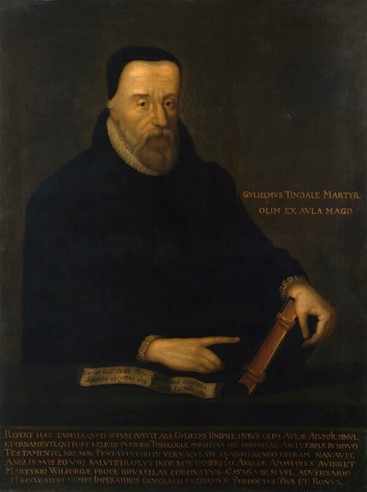
Many of us are familiar with the famous quotation from William Tyndale recorded by Richard Webb & quoted in David Daniell’s biography ‘William Tyndale A Biography’, Yale University Press, paperback edition, published as a Yale Nota Bene book in 2001 p79.
“And soon after Master Tyndall happened to be in the company of a learned man, and in communing and disputing with him drove him to the issue that the learned man said, we were better without Gods law than the Pope’s; Master Tyndall hearing that answered him, I defy the Pope & all his laws, and said if God spare my life ere many years, I will cause a boy that driveth the plough, shall know more of the scripture than thou dost.”
Fewer of us are familiar with the wider spiritual context in which Tyndale said it.
While it was some time after Tyndale actually completed his translation of the New Testament into English in 1525, Daniell on page 78 writes that in 1530, immediately on his consecration as Bishop of London, Stokesley “…..investigated his curates ‘in letters and in their capacity and suitability for those things that pertain to the care of souls’”. Of one group of 56 examined. 22 were barred from preaching because of their ignorance and 6 were allowed to continue but only as long as they studied and passed the subsequent Bishop’s examination.
Daniell also records that in 1551, even in the, so called, ‘God’s Gloucestershire’, the investigations of Bishop Hooper in Wooton under Edge, revealed, 9 vicars did not know how many commandments there were, 33 didn’t know where they appeared in the Bible and 168 could not repeat them. When asked about the Lord’s Prayer, 39 vicars did not know where it appeared in the Bible, 34 didn’t know who wrote it and 10 couldn’t even recite it.
It should therefore be no surprise to anyone that Tyndale both made this and similar comments and determined to do something to rectify it before he was called from time into eternity. Only eternity will reveal the extent of Tyndale’s success in his own divinely appointed mission, but there are some indicators of it.
One could list numerous phrases still in use today that were bequeathed to the English-speaking world by Tyndale. However, a number of somewhat unusual examples of the success of Tyndale’s work, include that outside the Old St Paul’s in 1526, 3000 copies of Tyndale’s NT in English were burned over 3 days, bought by the Bishop of London himself to censor the translation of scriptures into English. Similarly, William Tyndale became known as ‘the most dangerous man in England, though he spent most of his adult life abroad on the run.
Daniell says, Tyndale ‘made a language for England’, p3
Perhaps most significant of all though, is the recognition of Tyndale’s work by those who prepared the 1611 Authorised Version of the New Testament to make 9/10ths of it, Tyndale’s, p3. The same applies to the first half of the Old Testament, which is as far as Tyndale got, before being executed outside Brussels in 1536.
That same Authorised Version New Testament, 9/10ths of which was Tyndale’s, was the Bible of the English-speaking world for over 350 years, until the only official revision of it in 1881, the Revised Version. To this day many recognise it as the only ‘authorised version of the Bible’ 500 years later, totally unaware of the above. Hence writing this short blog commemorating the publishing of Tyndale’s New Testament in July 1525.
The big rediscovery however, that fuelled the flames of even the factual Biblical knowledge mentioned earlier and made it common knowledge, was the rediscovery of the gospel itself both in Germany, with Martin Luther and even here in the British Isles with the likes of Wycliff a century earlier and Tyndale.
Tyndale wrote powerfully and insightfully about the differences between the law and the gospel.
Preface of the Worms octavo edition of 1526. The text below is from Edward Arber’s introduction in The First printed English New Testament: translated by William Tyndale. Photo-lithographed from the unique fragment, now in the Grenville collection, British Museum: edited by Edward Arber. London: [The Selwood printing works], 1871. (Language slightly updated)
Note the difference between the Law and the Gospel. The one asks and requires, the other pardons and forgives. The one threatens, the other promises all good things to those who set their trust in Christ only. The gospel points to glad tidings, good news, and is nothing but the promise of good things. However, not everything is gospel that is written in the gospel book: for if the law wasn’t there, you could not know what the gospel meant, even as you could not see pardon, favour, and grace unless the law rebuked you, and declared to you your sin, misdeeds, and trespasses.
Repent and believe the gospel, as Christ says in Mark chapter 1. Always apply the Law to your deeds, and if you find the desire in the bottom of your heart to keep the law you will no doubt repent, and feel a certain sorrow, in yourself, pain, and grief in your heart, because you cannot fully desire to keep the law. Apply the gospel—that is to say Gods promises — to Christ’s deserving of them, and to the mercy of God and his truth, and you will not despair, but feel God to be a kind and a merciful father. His spirit shall live in you, and be strong in you, and the promises shall be given you at the last (though not immediately, lest you forget yourself, and be negligent) and all threatening shall be forgiven you for Christ’s blood’s sake—to whom commit yourself altogether—without considering or taking into account, either to your good deeds or your bad. (https://www.bible-researcher.com/tyndale2.html)
Such distinctions like this are still essential to authentic human existence today.
Man may have sought to replace God’s law with his own, but even that has proved to be a burden too great for anyone to bear. One only has to recall particular politicians rigorously demanding mask wearing during Covid, who were subsequently found to have either forgotten or deliberately not done so.
What hope then of anyone keeping God’s law? Only one hope, that someone else might keep it for us and His righteousness be counted to us who have broken it. But even that would not be enough. What about our past failures and even deliberate violations of Gods law? For that we would need someone who could be paid the wages for our sin, by dying instead of us, so that we might not die eternally.
Well, I know of only one person who made such extraordinary claims, the one who speaking about Himself said, “…….the Son of Man did not come to be served, but to serve and give His life as a ransom for many.” Matthew 20 v. 28
If you would like to explore William Tyndale’s life and legacy more the following videos from YouTube are extremely informative.